Why Poland Is Europe’s Most Underrated Summer Destination in 2026
Italy, Greece, France, Spain, and Portugal earn the hype for the “Best of Europe”. Although with the hype they come with the crowds, the inflated prices, and months of planning to lock in a decent hotel room. Poland barely gets a mention, which feels off once you look at what’s there.
This Poland summer travel guide isn’t trying to convince you that Poland is some secret paradise. It lays out what the country actually offers this summer, the cities worth your time, what things cost, and a couple of entry rule changes worth knowing before you book anything.
Why More Travelers Are Adding Poland to Their Summer Plans
Ask someone who’s been to Poland recently why they went, and “it’s stunning” isn’t usually the first answer, though parts of it are. More often, it comes down to logistics. You can see medieval old towns, Baltic beaches, and mountain trails in the same two-week trip without burning through your savings or fighting for a hotel room in August.
Poland is part of the Schengen Area, so once you’re in, getting to Germany or the Czech Republic is just a train ride away, with no border checks for most travelers. Then there’s the cost. Poland remains one of the more affordable European summer destinations at a time when prices have climbed nearly everywhere else on the continent. A dinner that costs you €30 in Paris might run half that in Krakow.
If you’re still weighing regions, our guide on summer destinations in Europe for UAE travellers breaks down the cost and experience differences in more detail.
Best Places to Visit in Poland in Summer
Kraków
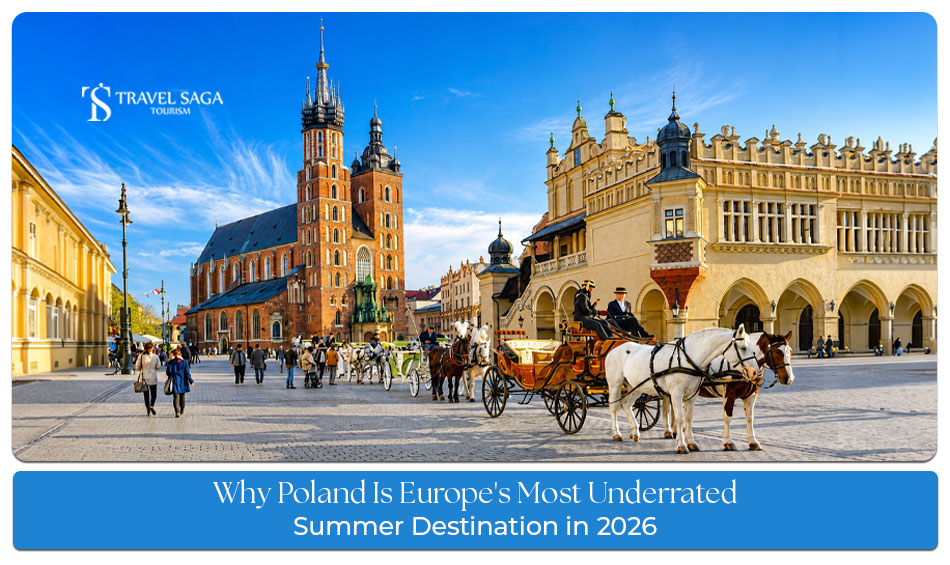
Kraków is where most people start, and it earns that spot. The Old Town is UNESCO-listed, Wawel Castle overlooks the Vistula River, and from here you can do day trips to the Wieliczka Salt Mine or the Auschwitz-Birkenau Memorial without much extra planning.
Warsaw
Warsaw gets compared to Krakow constantly and usually loses, which isn’t entirely fair. The capital’s Old Town was rebuilt almost brick by brick after WWII leveled it, and the contrast against its modern skyline is worth seeing. The Warsaw Rising Museum is worth a few hours on its own, and nightlife here tends to run later than in Kraków.
Gdansk
Gdansk sits on the Baltic coast and is one of the best places to visit in Poland in summer if a beach day is on your list, but you’d rather skip the crowds you’d find in Southern Europe. Sopot, right next door, has the resort-town energy if that’s what you want; Gdansk itself leans more toward amber shops and colorful merchant houses along the river.
Zakopane
Zakopane, down in the Tatra Mountains, is about as close as Poland gets to an alpine town, minus the alpine prices. Trails here range from flat lakeside walks to routes that will genuinely challenge you.
The Masurian Lake District
The Masurian Lake District doesn’t get much attention outside Poland, but it’s where many Poles spend their own summer holidays: thousands of lakes, good conditions for sailing or kayaking, and a slower pace than the cities.
Wroclaw
Wroclaw rounds things out with a colorful Market Square, river islands you can wander between, and hundreds of small bronze dwarf statues tucked around the city, an odd detail nobody warns you about until you’ve tripped over your fifth one.
Between these six, you’ve got most of what people search for under “best places to visit in Poland in summer”: coastline, mountains, history, and a couple of cities that don’t feel like every other European capital. You can get your customised Poland tour package with us.
When to Go: Poland’s Summer Weather Explained
A Poland summer travel guide isn’t much use if it skips the weather, so here’s the practical version. Summer runs June through August, with average daytime temperatures between 20°C and 25°C (68–77°F). July and August occasionally push toward 30°C (86°F) inland, in Warsaw and Krakow especially.
Compared to a Roman or Athenian summer, that’s mild, you can walk around at 2 p.m. without hunting for shade every ten minutes. Pack a light rain layer regardless of where you are; the mountains in particular get sudden showers even at the height of summer.
How Poland Compares as One of the Affordable European Summer Destinations
Cost is usually what tips the decision when people are choosing between European destinations, and it’s where Poland has a real edge.
Everyday Costs: Currency, Food, and Transport
Poland still uses its own currency, the złoty (PLN), not the euro, which already works in your favor if you’re converting from dollars, pounds, or most major currencies. A sit-down meal at a decent restaurant typically costs less than half what you’d pay in Paris or Amsterdam, and trains, museum tickets, and hotel rooms follow a similar pattern.
If you want to eat the way locals do for a fraction of restaurant prices, look for a milk bar (bar mleczny), government-subsidized canteens serving traditional Polish food cheaply, a holdover from an older era that’s stuck around because it works.
For a wider look at how Poland compares to other budget-friendly options, our roundup of why Poland Why is becoming Europe’s budget travel alternative breaks down total trip costs across several countries, Poland included.
Getting Around and Entry Requirements in 2026
Getting Around Poland
Travelling from one place to another is fairly simple: PKP Intercity covers the major cities, and budget airlines fly into smaller regional airports if you’re combining Poland with other stops in Central Europe.
Entry Requirements for 2026
A couple of entry-rule changes are worth knowing about this year. The EU’s Entry/Exit System (EES), which records biometric data, fingerprints, and a photo at Schengen borders, went live in April 2026. It doesn’t require any advance application; border officials handle it when you arrive. You can apply Poland visa from UAE for a smooth nad hassle free process.
ETIAS, the separate travel-authorization system, still hadn’t launched as of mid-2026 and is expected sometime in the final quarter of the year. Practically, that means travelers visiting Poland this summer won’t need an ETIAS authorization, though it’s worth double-checking closer to your travel dates, since the timeline has shifted more than once already.
Non-EU travelers should also confirm their passport’s validity window before booking. Read our What is the purpose of a Schengen visa to learn more about the Schengen Visa process.
Food, Culture, and a Few Practical Tips
Polish Food Worth Trying
Polish food doesn’t get talked about as much as Italian or French cooking, but it’s hearty, affordable, and better than its reputation suggests. Pierogi show up everywhere, kielbasa is unavoidable in a good way, and bigos, a slow-cooked hunter’s stew, is worth ordering at least once. Vegetarian options have expanded considerably in recent years too, especially in Krakow and Warsaw.
English is widely spoken in cities and tourist areas, but less so in smaller towns. A handful of Polish phrases, hello, thank you, the bill, please, go further than you’d expect.
A Few Smaller Things Worth Knowing
- Tipping around 10% is standard at restaurants, though it’s not necessary.
- Tap water is safe to drink in most cities.
- Sundays can mean limited shop hours in smaller towns, due to trading restrictions still in place.
If you want a packing list built around Poland’s actual summer climate rather than a generic Europe list, our Europe summer packing guide covers both city days and mountain hikes.
Final Thoughts
Poland isn’t trying to be the Amalfi Coast, and it doesn’t need to be. What you get instead is a country that’s easier on your budget, lighter on crowds, and varied enough that a two-week trip doesn’t start to feel repetitive: mountains one week, coastline the next, history woven through all of it.
That’s the point of this Poland summer travel guide: not to oversell the country, just to help you decide if it fits this year’s trip. If Krakow, Gdansk, or the trails around Zakopane caught your attention. travelsaga.com is there to help you out at every step. Book your trip now.