Top Spiritual And Cultural Experiences in Nepal
There’s a moment that most people describe after arriving in Nepal, usually somewhere between stepping off the plane and walking into their first temple courtyard, where the noise of everyday life just falls away. It’s not dramatic. It’s quiet. And it tends to stick with you.
Nepal is one of the few places in the world where spirituality isn’t a tourist attraction layered on top of daily life. It is daily life. Monks spin prayer wheels at dawn. Priests recite Sanskrit beside temple fires at dusk. Spiritual tourism in Nepal has grown steadily for good reason; the country genuinely delivers on what so many destinations only promise.
Whether you’re a pilgrim, a curious traveller, or someone who simply wants to understand a place more deeply, this guide covers the best spiritual places to visit in Nepal and the cultural experiences that make a trip here unlike anything else in Asia. The best part is you can make your customised Nepal tour packages from UAE with us and include all these places in your itinerary.
Why Nepal Draws Spiritual Travellers From Around the World
Nepal holds a position that no other country does. It is the birthplace of Buddhism and, at the same time, one of Hinduism’s most sacred sites. These two traditions have coexisted here for over two millennia, not just peacefully, but actively, with shared festivals, shared temples, and a layered religious culture that’s genuinely unlike anywhere else.
Travel Saga’s Nepal Travel guide takes you through the experiences that will stay with you for life.
The numbers reflect this. Nepal has more than 2,700 Buddhist monasteries and thousands of Hindu temples, including eight UNESCO World Heritage Sites connected to faith and history. Over 1.1 million international visitors arrived in 2024, and spiritual and cultural tourism has been identified as a key growth sector in Nepal’s own Tourism Strategic Plan through 2030. What explains it is being able to walk from a Buddhist stupa to a Hindu temple in under ten minutes, with both of them full of people who are there to pray, not to be photographed doing it.
Spiritual tourism in Nepal works because it’s real. Read do UAE residents need a visa for Nepal, if you’re planning your travel from the UAE.
Enquire - Nepal Tour from Dubai
Best Spiritual Places to Visit in Nepal
1. Pashupatinath Temple, Kathmandu
If you visit only one place in Nepal, make it Pashupatinath. It sits on the banks of the Bagmati River in Kathmandu and is Nepal’s most sacred Hindu temple dedicated to Lord Shiva, a UNESCO World Heritage Site, and a living religious complex that has been in continuous use for over 2,000 years.
The complex is enormous. Hundreds of shrines, statues, and ritual spaces are spread across both sides of the river. The most striking thing, though, is the cremation ghats along the riverbanks. Watching cremation ceremonies here is confronting for some people, peaceful for others, but almost universally described as one of the most honest experiences you can have as a traveller.
Non-Hindu visitors can’t enter the main sanctum, but you can observe everything from the eastern bank of the river. The best times to visit are early morning and evening, when the activity is at its height. The festival of Shivratri is one of the best time to visit the temple; if you plan to visit Nepal in february.
Practical tip: Dress modestly with covered shoulders and legs. Arrive early to avoid crowds and get a quieter first impression of the site before the tour groups arrive.
2. Boudhanath Stupa, Kathmandu
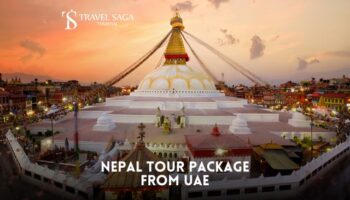
About 7 kilometres northeast of central Kathmandu, Boudhanath is one of the largest Buddhist stupas in the world. It’s also one of those places that is genuinely difficult to describe without sounding like a travel brochure, so let’s try a different approach: go in the evening, find a rooftop café with a view of the stupa, order a tea, and just sit there for an hour.
The stupa is believed to date back to the 5th century and is the spiritual centre of Tibetan Buddhism in Nepal. Spiritual tourism in Nepal owes a great deal to Boudhanath. For many travellers, it’s where the trip shifts from sightseeing to something harder to name. If you want to go deeper, Kopan Monastery, nearby on a hillside, offers meditation retreats and teachings in English. It’s worth looking into even if you only have a day. If you are planning to visit the country from India, then do check our Nepal tour packages from India.
Practical tip: Early mornings are quieter and more meditative. Evenings have more energy and better light. Try to go at both times if you can.
3. Lumbini – Where the Buddha Was Born
Lumbini is in the Rupandehi district in southern Nepal, far from Kathmandu and a different kind of destination entirely. This is the birthplace of Siddhartha Gautama, the person who became the Buddha. For around 500 million Buddhists across the world, it’s among the most sacred places on earth.
The Maya Devi Temple marks the exact spot of the birth. An Ashoka Pillar, erected by Emperor Ashoka in 249 BC, still stands nearby. The Sacred Garden that surrounds it has ancient ruins, a Bodhi tree, and a reflective pond. Around the garden, monasteries built by Buddhist communities from Japan, China, Thailand, Germany, Myanmar, and many others create an unexpected cross-cultural quiet.
Practical tip: November to February is the most comfortable time to visit, weather-wise. Fly to Bhairahawa Airport (about 20 minutes from Lumbini by road) or take a bus from Kathmandu if you want to see the countryside en route.
4. Swayambhunath (Monkey Temple), Kathmandu
Swayambhunath sits on a forested hill above Kathmandu Valley and is one of Nepal’s oldest religious sites, sacred to both Hindus and Buddhists, which tells you something about the kind of spiritual coexistence Nepal has always practised.
Most people know it as the Monkey Temple, because of the large and occasionally pushy population of rhesus monkeys that treat the hill as their territory. At the summit, the stupa’s painted eyes of the Buddha look out over the entire valley. On a clear day, the view is one of the best in Kathmandu.
Practical tip: Arrive early. Go on a clear day for the views. Keep your bags closed and your snacks out of sight the monkeys are experienced thieves.
5. Muktinath Temple, Mustang
Muktinath is the most out-of-the-way destination on this list, and in many ways the most extraordinary. It sits at 3,710 metres in the Mustang district, deep in the Himalayas, and it is one of the rare places on earth genuinely sacred to two different religions, Hinduism and Buddhism, simultaneously and without compromise.
The temple complex has 108 water spouts arranged in a semicircle. Pilgrims bathe in them as an act of spiritual cleansing, and yes, the water is extremely cold. Getting to Muktinath is itself part of the experience. The landscape through the Mustang high-altitude desert, dramatic rock formations, and ancient villages is unlike anything else in Nepal.
Practical tip: The Annapurna Circuit trekking route passes through Muktinath. You can also reach it by jeep from Jomsom if you’re not trekking, but check road conditions first, as they vary by season.
Additionally, read can you enjoy Nepal without trekking if you want to know more.
Cultural Experiences in Nepal: The Festivals You Should Know About
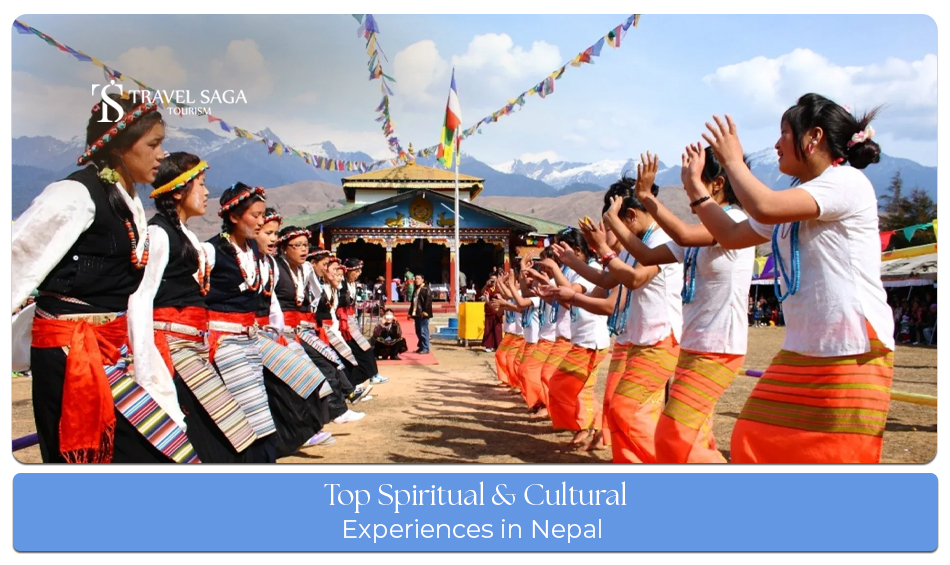
Nepal has more than 125 ethnic groups and 123 languages. That diversity shows up most vividly in its festivals, which are woven into the national calendar year-round and genuinely involve the whole country.
Dashain (September–October) is Nepal’s biggest festival a 15-day celebration of Goddess Durga’s victory over evil. On the tenth day, Vijaya Dashami, elders bless younger family members with a tika of rice, vermillion, and yogurt, and jamara (barley sprouts) grown specially for the occasion. It’s one of the warmest experiences Nepal offers any visitor.
Tihar (late October–November), the Festival of Lights, follows Dashain by about two weeks. Over five days, crows, dogs, cows, and Goddess Laxmi are each honoured in turn and on the final day, sisters perform Bhai Tika to bless their brothers. Streets across Kathmandu and beyond glow with oil lamps, rangoli patterns, and candles.
Indra Jatra (September, Kathmandu) is harder to explain and better to simply see. It features the chariot procession of the Kumari Nepal’s living goddess, alongside traditional Lakhe masked dances and Newari music. It’s one of the most distinctive urban festivals in all of South Asia.
Buddha Jayanti (May) marks the birth, enlightenment, and passing of the Buddha. At Boudhanath and Lumbini, it’s one of the most peaceful gatherings on the calendar, quiet and deeply sincere.
A note on planning: spiritual tourism in Nepal during these festivals is deeply rewarding, but transport and accommodation fill up fast, especially around Dashain, when much of the country is on the move. Read more about us and choose what works for you the best.
A Few Practical Things to Know Before You Go
When to visit: Autumn (September to November) and spring (March to May) are the best seasons, with good weather, major festivals, and the trekking routes open.
Getting around: The main spiritual sites in the Kathmandu Valley are reachable by taxi or local bus. Lumbini is a separate trip; fly to Bhairahawa (about 45 minutes) or take a bus (around six hours). Muktinath requires either the Annapurna trekking route or a jeep from Jomsom.
Visas: Tourist visas are available on arrival at Tribhuvan International Airport in Kathmandu. Most nationalities can get 15-day, 30-day, or 90-day options.
What to wear: Modest clothing with covered shoulders and legs is expected at temples. A shawl or light scarf is useful to carry. Comfortable, sturdy footwear matters more than most people expect. Lots of steps, cobblestones, and uneven ground.
Note: For curated itineraries and professionally insights explore our International tour packages.
Conclusion
The best spiritual places to visit in Nepal are not really about the places. They’re about what happens when you’re standing in them, the stillness at Lumbini at dawn, the sound of the kora at Boudhanath, the heat of the aarti at Pashupatinath, the cold of the water at Muktinath.
Spiritual tourism in Nepal works because the country hasn’t separated its sacred life from its everyday one. The temples are still being used. The festivals are still being held. The cultural experiences in Nepal that stay with travellers longest are the ones that feel borrowed from real life not staged for them. If you’re planning a trip and want help putting together an itinerary that goes beyond the obvious, travelsaga.com covers destinations, seasons, and practical planning in more detail.